4 Bridges Walk Storybook
The Swinging Bridge
Pages River, near Mayne Street
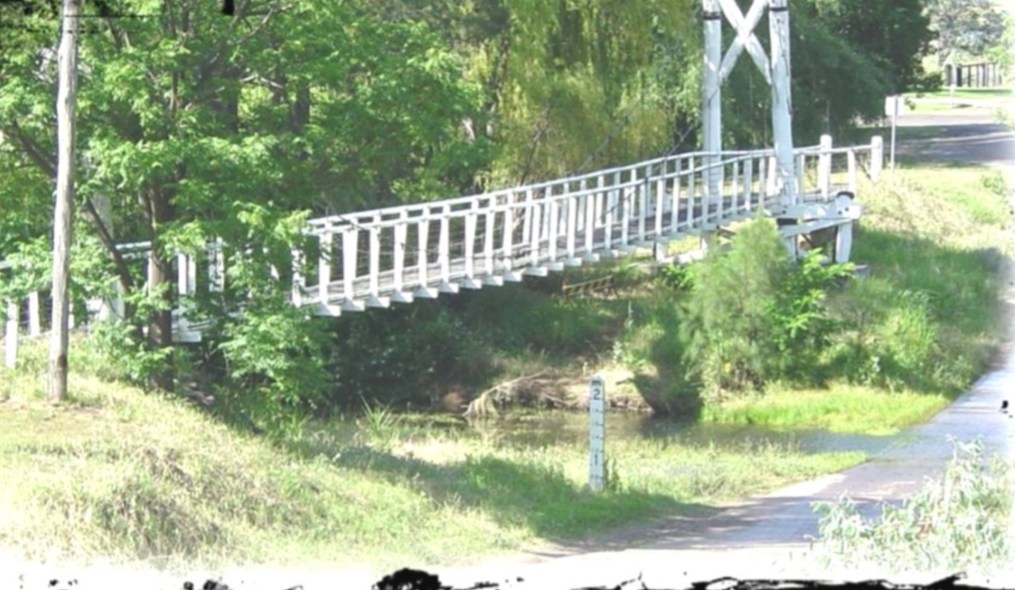
This is the third bridge on this site, originally called Gordon's Bridge after Dr Gordon, who initiated local fundraising to build it after an earlier bridge was washed away in the 1870 flood. The bridge we see today was built by Keegan in 1927.
The Courthouse and the Royal Hotel were both built in 1863. Judges travelling to Murrurundi for legal sessions stayed at the Royal Hotel and then crossed to the Court House - but the Pages River was frequently too deep to safely cross, so a bridge was built for his Honour's convenience.
EG Bush Bridge
Near Liverpool Terrace
Built in 1976, this walkway bridge provides easier access to St Luke's Church. It was originally built with a steep stairway to climb on the northern end - in 2009 the walkway was modernised and ramps were built at both ends to replace the stairs.
Railway Cutting Bridge
Near Mount Street
A road bridge built for the ease of local settlers - such as the Teys, who owned the sandstone quarry, and other families living closer to the start of the Pages River - so they could reach their properties without being forced to take a much longer route home. The rail line had cut through the hill as it progressed toward the Ardglen tunnel.
The State Rail Authority planned to demolish this bridge in 1991, but it was saved by the efforts of the Murrurundi Historical Society and remains a reminder of the town's heritage.
Railway Station Footbridge
Near Haydon & Victoria Streets
The railway came to Murrurundi in 1873. As the engines were wood-fired steam engines, the water to produce steam needed topping up frequently - the water tower was constructed to fill the boilers, and still stands today as a reminder of when Murrurundi was the centrepiece of the old steam locomotive depot.
Murrurundi was once a very busy railway station, the centre of the northern railway operations until 1926, when operations shifted to Werris Creek. The station had housed a restaurant, a newspaper shop and other conveniences for passengers while old steam trains took on fuel, water and extra engines to haul the train up the range and through the Ardglen tunnel.